
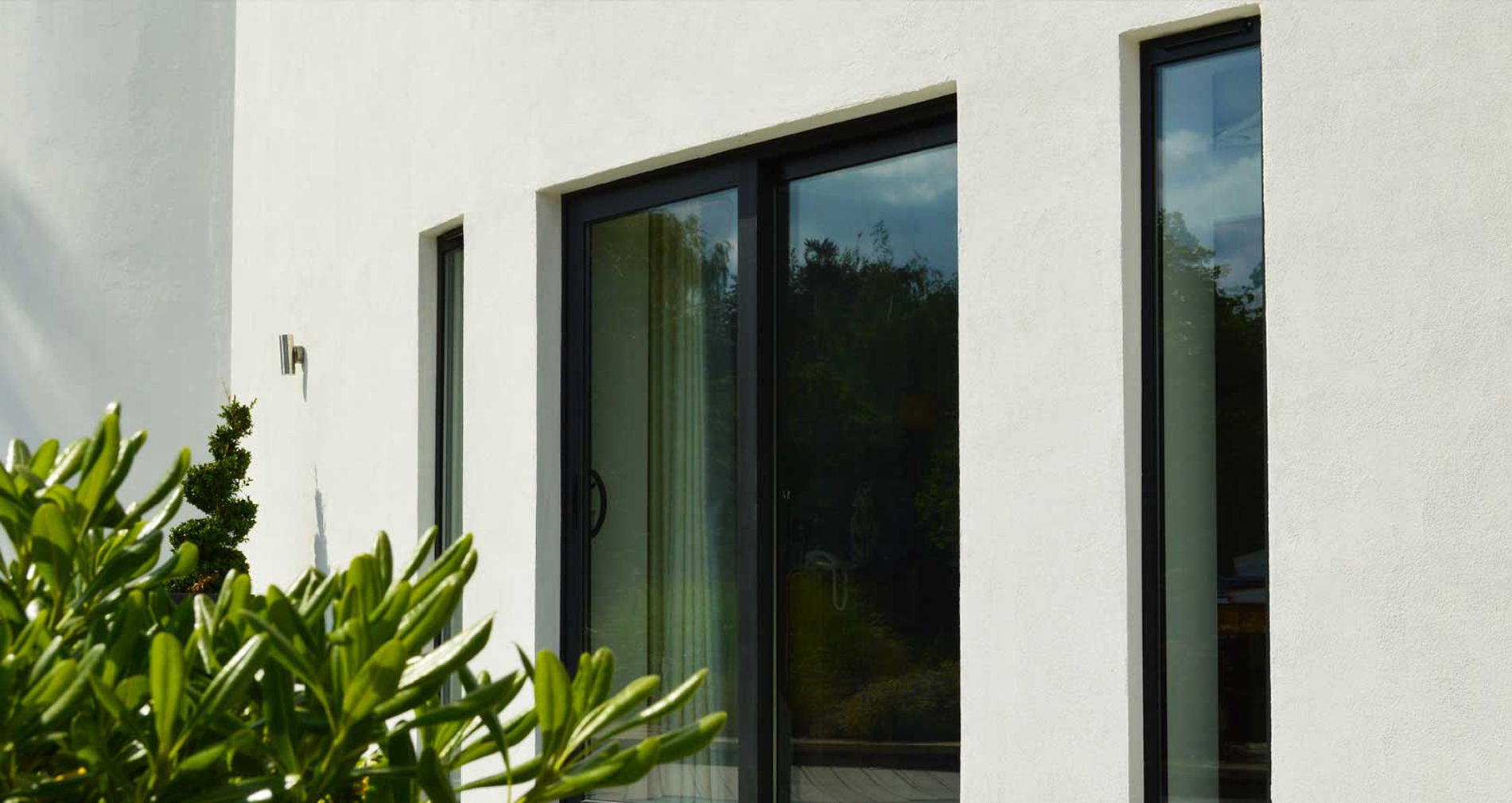
Patio Sliding Doors
Wide garden access with no swing clearance or folding mechanism
We have been fitting sliding patio doors across South Buckinghamshire and East Berkshire since 2003. Every installation is FENSA registered and completed by our own team.
Sliding patio doors fitted across South Bucks and East Berkshire
The practical alternative to bi-fold doors for homes where the space beside the opening matters as much as the opening itself.
A sliding patio door operates on a horizontal track: one or more panels slide in front of the fixed panel or panels, moving parallel to the wall rather than swinging into the room or folding alongside the frame. The result is a door that requires no clearance inside the room, no external landing for a swing arc, and no space beside the frame for a stack of folded panels. The glass area when closed is large — comparable to a bi-fold system of the same width — and the view through a well-specified sliding door when it is shut is uninterrupted. For properties where the room layout or the position of the opening makes a bi-fold or French door impractical, a sliding patio door is often the answer that works.
The most common reason homeowners arrive at this page is that something has ruled out their first choice. A rear room where furniture cannot be moved further back to accommodate a bi-fold stack. A kitchen with an island that sits close to the back wall. A garden that does not have the level hard surface needed for a French door to open onto comfortably. Sliding patio doors solve each of these problems cleanly. They also suit properties where the existing opening is wide but the budget for a full bi-fold system is a consideration — a two or three-panel sliding door covers a wide opening at a more contained cost. We will assess your opening during the home visit and give you an honest view of which door type, at which specification, makes the most sense.
Why it matters
What sliding patio doors bring to your home
Space
No swing clearance required — the room layout is unaffected
The fundamental practical advantage of a sliding patio door over any hinged alternative is that it takes up no floor space when it opens. A French door swings outward into the garden or inward into the room — both require clearance. A bi-fold door stacks against the side of the frame, which requires usable space beside the opening. A sliding door moves parallel to the wall and demands nothing from the room or the garden. This makes it the only viable option for some openings — particularly in kitchens where an island or fitted furniture sits close to the back wall, or in rear rooms where the furniture arrangement makes a swing clearance area impractical.
Light
Large uninterrupted panes with minimal framing when closed
A sliding patio door presents a large area of glass even when it is fully closed. The fixed panels are floor-to-ceiling or close to it, with minimal framing around the perimeter, and the view through the glass is unbroken by any folding mechanism or intermediate frame. In aluminium, the profiles at the overlap point where the panels meet are slim enough to have little visual impact on the view. For rear-facing rooms across the South Bucks area — where the garden is the primary prospect and where natural light from the rear is the main daylighting source — maximising the glazed area in the closed position matters as much as the access the door provides when open.
Simplicity
One smooth movement, no folding, no refolding required
A sliding patio door operates in one direction on one track. There is nothing to unfold, no sequence of panels to manage, and no concern about what happens to the stack when the door is not fully open. For households that use the garden access regularly throughout the day — for children moving between inside and outside, for dogs, for everyday ventilation — the ease of operation is a genuine consideration. The sliding mechanism on a well-specified system is smooth enough for a single hand to operate easily. The access point when fully open is clear and wide enough to move furniture through, carry things in from the garden, or step outside in a single stride.
Security
Multi-point locking and anti-lift protection as standard
Patio doors have historically been seen as a security vulnerability — older sliding systems with single-point latches and tracks that allowed panels to be lifted free were genuinely easier to force than a front door. Modern sliding patio doors fitted with multi-point locking and anti-lift bolts are a different proposition. The mechanism engages the frame at multiple points simultaneously, and the anti-lift device prevents the panel from being removed from the track from outside. Combined with toughened laminated glazing, a correctly specified sliding patio door provides security comparable to any other external door in the home.
Our work
Sliding patio doors fitted across South Bucks and East Berkshire
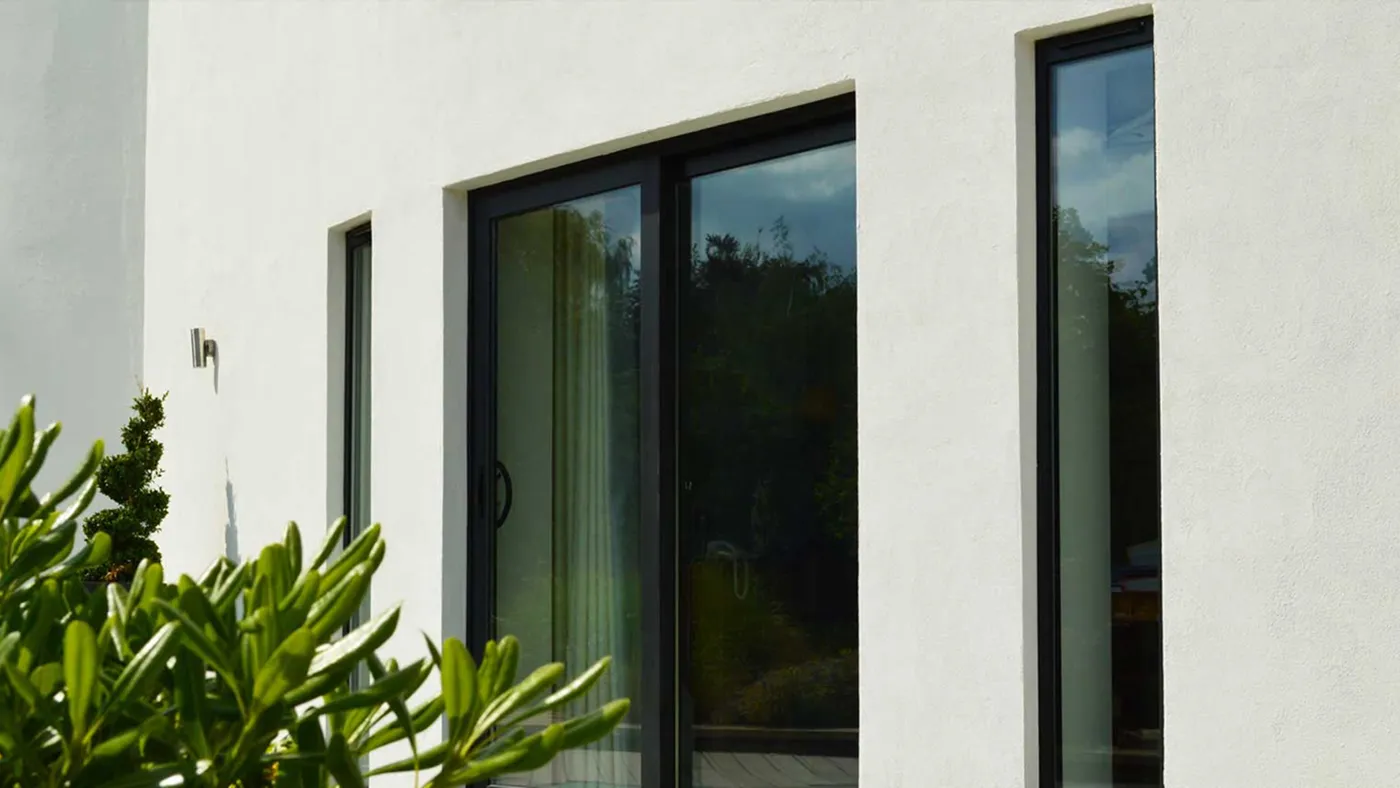
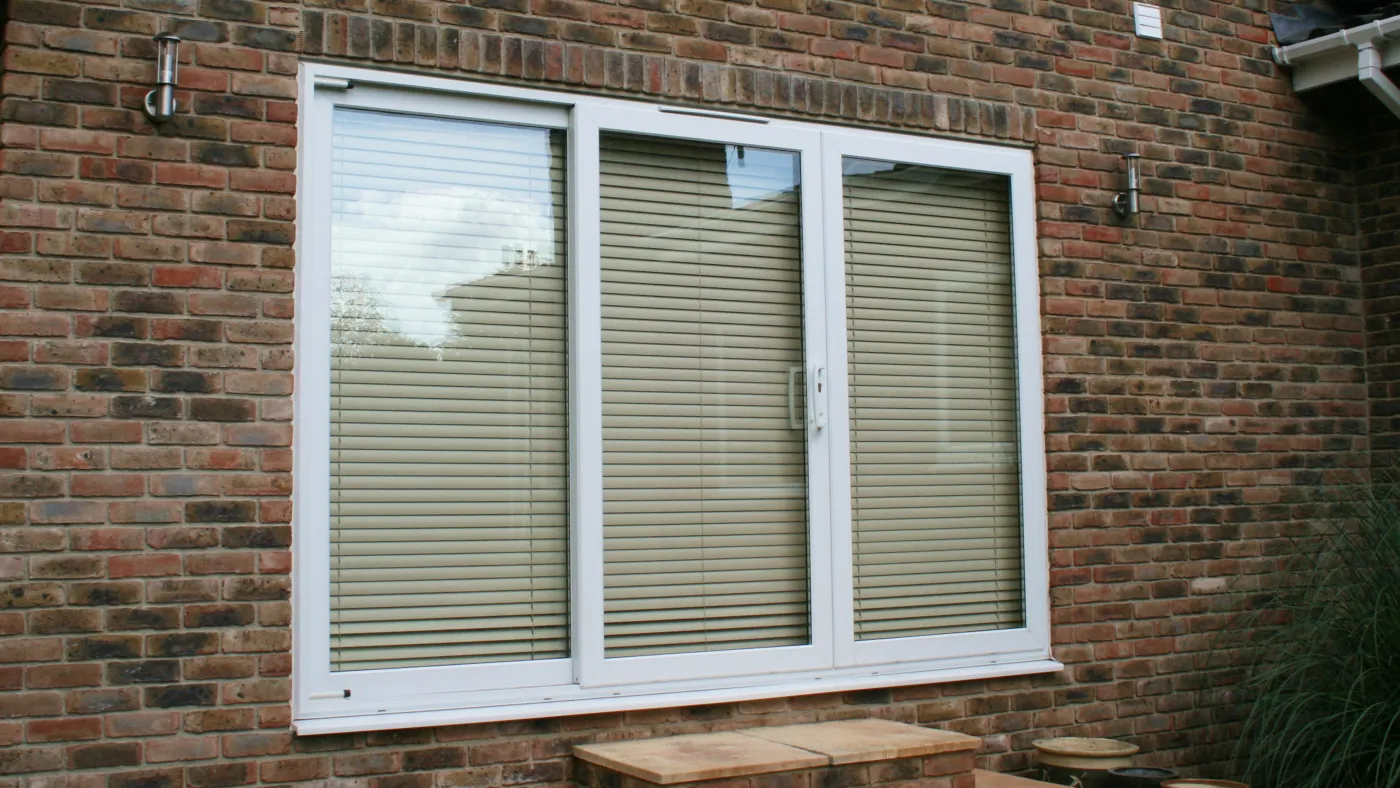
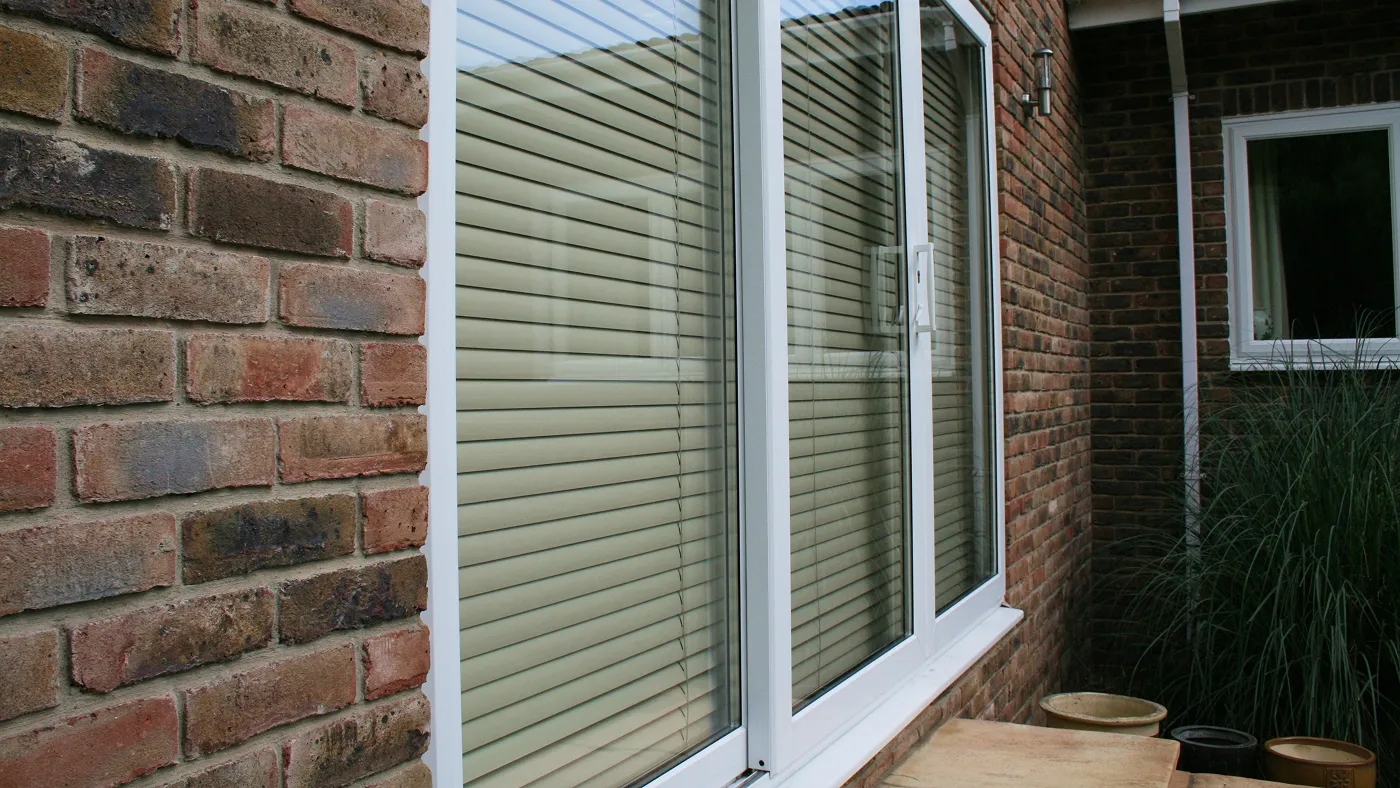
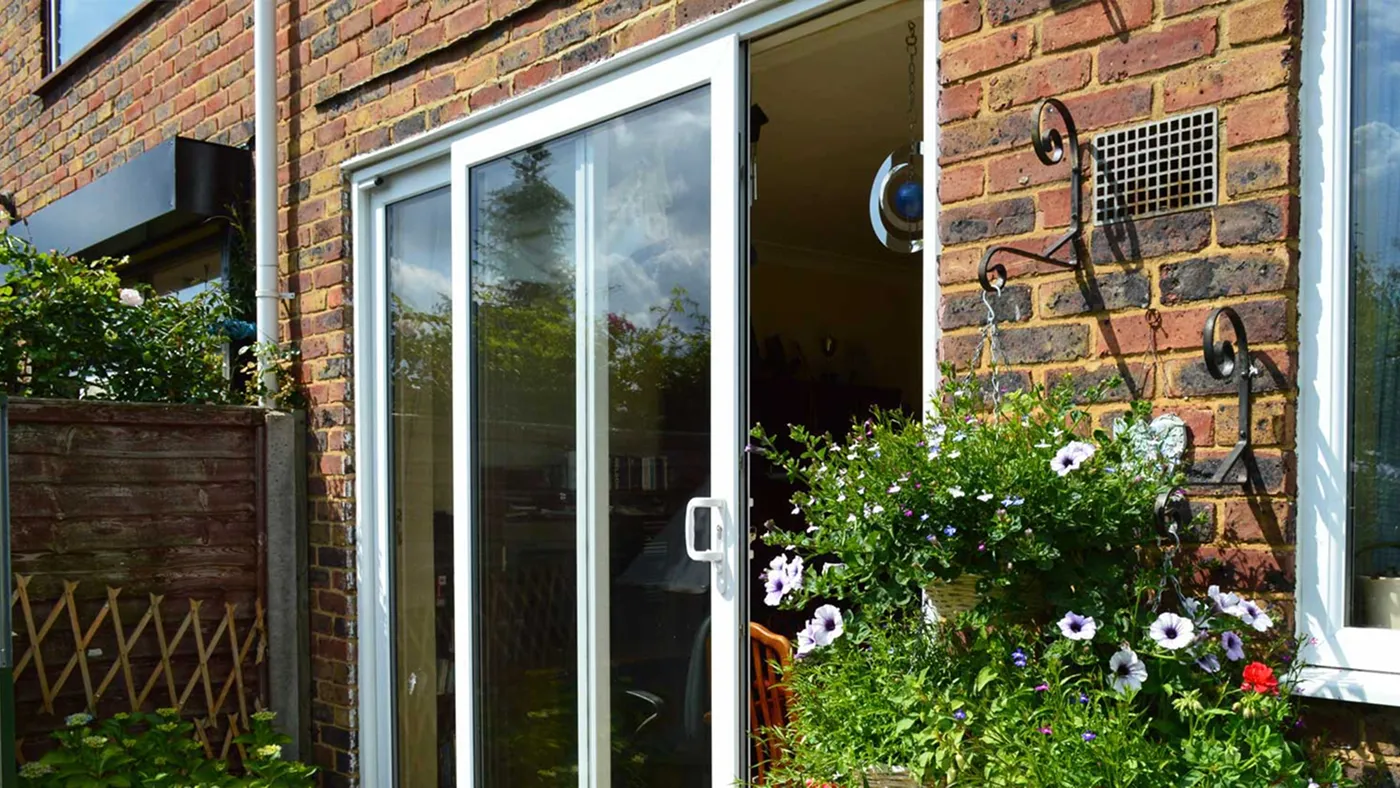
Anthracite grey patio doors · Ascot
01 / 04Configurations
Two, three, or four panels — and which ones slide
Sliding patio doors can be configured in several ways depending on the width of your opening and how much of it you want to open up. The panels that slide and the panels that remain fixed are decided during the survey.
Most Common
Two-panel — one fixed, one sliding
The standard sliding patio door: one panel is fixed in the frame, and one slides in front of it along the track. The sliding panel opens to one side, leaving approximately half the total width of the opening as a clear access point. This is the configuration found on the majority of existing patio door installations across the South Bucks area, and when replaced with a well-specified aluminium or uPVC system it represents a straightforward, high-value upgrade. The overall frame size and opening position are unchanged, so there is typically no structural work involved beyond removing the old door and fitting the new system.
Best for
For Wider Openings
Three or four panel — more glass, wider opening
Wider openings — or openings where the homeowner wants to maximise the access width — can be fitted with three or four-panel sliding configurations. In a three-panel system, typically two panels slide and one is fixed, or one slides and two are fixed with the sliding panel moving behind them. In a four-panel system, both outer panels can slide toward the centre, opening up a wide central access point. The configuration is determined by the width of the opening and the space available beside the frame, and we discuss the options during the survey. Wider sliding systems suit rear extensions and kitchen-diners in Gerrards Cross, Beaconsfield and the larger detached properties along the A40 corridor.
Best for
What to consider
The decisions that shape how your patio doors perform
Sliding patio doors involve fewer configuration decisions than bi-fold systems, but the material choice, glazing specification, and threshold design still need to be right for your property. We cover all of this during the home visit.
01
Frame material — aluminium or uPVC
Aluminium sliding patio doors offer slimmer sightlines, a wider colour range, and greater dimensional stability over time. uPVC sliding doors are a well-established and thermally capable option, particularly suited to like-for-like replacements where the existing frame is uPVC and the opening is a standard size. The difference in visible profile width between aluminium and uPVC is more noticeable in a sliding door than in a hinged door because the panels overlap when the door is closed, creating a central zone where two sets of profiles are visible. In aluminium, this reads as a clean sightline; in uPVC, the profiles are slightly more prominent. Neither is wrong — the right choice depends on the property and what else is specified around it.
Practical note
We bring frame samples to the home visit so you can compare the profile sizes and finishes against your existing joinery and brickwork.
02
Glazing and thermal performance
The thermal performance of a sliding patio door is primarily determined by the glazed unit specification — the type of glass, the number of panes, the gap fill, and the low-emissivity coating. Standard double-glazed units with argon fill and low-emissivity glass perform comfortably within current building regulations and are the appropriate specification for most installations. For south or west-facing rear aspects that receive significant direct sunlight — common on properties in Ascot, Windsor and parts of Gerrards Cross — solar control glass can reduce heat gain and prevent the room from becoming uncomfortable in summer without reducing the light quality meaningfully.
Practical note
Triple-glazed sliding units are available and can be appropriate for particularly exposed aspects or for homeowners who want the highest thermal performance specification.
03
Track and threshold design
The track that the sliding panel runs on sits at the base of the frame and is the point where the door meets the floor level. A low threshold — where the track sits as close to floor level as possible — creates the cleanest visual connection between inside and outside and improves accessibility. The trade-off is that a very low threshold provides less of a physical barrier against water driven by wind and rain. We assess the exposure of your rear aspect and the relationship between internal floor level and external ground level during the visit, and recommend the threshold that gives the best balance of appearance and weather performance for your specific situation.
Practical note
The track must be kept clear of debris — leaves, grit, and dust can prevent the panel from sliding fully and compress the seals unevenly. We show you the correct maintenance routine before we finish.
04
Locking and security specification
Modern sliding patio doors are secured by a multi-point locking mechanism that engages the frame at top, bottom, and mid-point when the handle is turned, in the same way as other external doors. Anti-lift devices prevent the panel from being lifted off the track from outside. The cylinder — or the hook lock where no cylinder is used — is specified to anti-snap standard as a matter of course on all our external door installations. On wider multi-panel systems, each sliding panel is locked independently, and the fixed panels are secured within the frame structure rather than relying on the same locking mechanism.
Practical note
We test the locking mechanism on every panel before we leave and walk you through the correct operation — including how to engage the secondary security bolts if fitted.
Reviews
What your neighbours are saying
Real reviews from homeowners across South Bucks and East Berkshire. Every one verified through Google.
We couldn't be more happier with your lovely work men who were very polite and helpful. We will call again one day x
Mrs Ryan
Hayes
We were very happy with the service we received. We understand the delays were out of your control. The guys who came to fit the windows were really nice and efficient. Joe has been lovely from start to finish on this job! Alpha Windows has given us the best level service from all the window companies that we spoke to. The other companies had poor service and one of them was quite rude. So overall, we can't complain and are happy we went with Alpha windows!
Mr & Mrs Hussain
Stoke Poges
I should have posted this 4 years ago when I had my windows done but was lazy extremely happy with all my windows & front door. I wanted to check something’s. Amazing customer service from Victoria! & Joe came round the next day after 4 years! Cannot recommend Alpha enough! Only company I will be using. Thanks all at Alpha.
Tim Davis
Iver
We have been regular customers of Alpha Windows for some time and have always found them professional and easy to deal with. Visits for quotes are arranged swiftly and quotes are received promptly too. The fitting team are always very helpful, do a good job and leave the premises clean and tidy.
Hannah Graves
Gerrards Cross
It has been a total pleasure to work with you all over the last couple of months. Since the drama with Ridgwell we were worried about trusting another company but from the first contact with you via phone and seeing you face to face in the showroom we were put at ease. You were so friendly and listened to our needs and worries and helped us chose what was right for us.
Claire
Iver
From the initial engagement right through to the installation, Alpha Windows have been outstanding. Every question I had was answered promptly and clearly, and they were extremely helpful in accommodating my requested design. The pricing was very competitive, and the final product exceeded my expectations — the door and surrounds are absolutely beautiful.
Nicola
Gerrards Cross
Common questions
What homeowners ask us about sliding patio doors
-
The operating mechanism is the core difference. A bi-fold door folds panels concertina-style, stacking them beside the frame and creating a wider opening relative to the overall frame size. A sliding door moves one or more panels sideways on a track, leaving the other panels fixed. Bi-fold doors are the better choice where the priority is maximising the access width — the opened aperture of a fully folded bi-fold is wider than that of a sliding door of the same frame width. Sliding doors are the better choice where there is no room for the panel stack beside the frame, where the room layout does not allow for swing clearance, or where a simpler operating mechanism is preferred. Budget is also a factor — sliding patio doors are generally more cost-effective than bi-fold systems of a comparable specification. We discuss all of this honestly during the home visit.
-
Early and lower-quality sliding patio door systems have a reputation for draughts and poor weather sealing, and that reputation is not entirely undeserved. The nature of the sliding mechanism means the seal at the track level is inherently less straightforward than a compression seal on a hinged door. Well-specified modern systems address this with multiple weather seals along the panel edges, a correctly designed low threshold, and precision-engineered tolerances that keep the gaps between panel and frame consistent. A system fitted by an experienced team, set accurately level and plumb, will not be draughty in normal use. If your existing sliding doors are draughty, we assess whether the cause is the product, the installation, or accumulated wear — and we advise honestly on whether adjustment or replacement is the right approach.
-
Replacing an existing sliding patio door like-for-like — same size, same position — does not normally require planning permission. Enlarging an existing opening to accommodate a wider sliding system may require building regulations approval for the structural element. Properties in conservation areas — including parts of Windsor and Beaconsfield Old Town — and listed buildings have additional requirements regarding material choice and appearance. We identify what applies to your property during the home visit and advise accordingly before any work is agreed.
-
A standard two-panel sliding patio door replacement — removing the existing door and fitting the new system in the same opening — is typically completed within a day. Wider systems or those requiring any structural preparation may take two days. We give you a specific, realistic timeline during the quoting process and do not book an installation date until everything is agreed and confirmed in writing.
-
For most window and door replacements, no. Like-for-like replacements fall under permitted development rights and require no planning permission. If your property is in a conservation area — parts of Windsor and Beaconsfield Old Town, for example — or if it's listed, there may be restrictions on colour, style, or material. We know the local areas well and will flag anything relevant during your visit.
-
Yes. FENSA registration means every installation we complete is certified to meet current building regulations, and the work is registered with your local authority automatically. This is important if you ever sell your home — solicitors will ask for it. You don't need to do anything; we handle the registration on your behalf.
-
Our installations come with a 10-year guarantee as standard, covering both frames and sealed glazing units. Combined with FENSA registration and our full public liability insurance, you're protected throughout the installation and long after completion.
-
Yes. We remove all old frames and glass and dispose of them responsibly. We also leave your home clean and tidy at the end of every job — it's part of how we work, not an optional extra.
-
We don't consider a job complete until you're satisfied. If something isn't right, tell us and we'll fix it. Our reputation in South Bucks has been built over 20 years — we have every reason to make sure you're happy.
The process
What happens from first contact to finished installation
Get in touch
Tell us what you are thinking
Fill in the short form below or give us a call on 01753 663663. There is no obligation and no sales process triggered by making contact — just let us know what you are considering and we will take it from there.
We visit your home
A proper look at your property
We visit at a time that suits you — usually within a few days. We measure every opening, assess what is there, and talk through your options honestly. We bring samples so decisions can be made against your actual property in natural light.
Your written quote
Clear costs, no surprises
We follow up with a written quote that covers everything involved. No hidden charges, no items that appear later. There is no pressure to decide on the day and no uninvited follow-up calls. You take as long as you need.
Installation
Done properly, left tidy
Our fitters work through each opening one at a time so your home is never left exposed. Furniture and flooring are protected throughout. Old frames are removed and disposed of. Before we leave, everything is tested and you are walked through the result.
Free no-obligation quote
Get a free quote for your sliding patio doors
Tell us about your opening and what you are looking to achieve. We will be in touch within one working day to arrange a visit at a time that suits you — no obligation, no automated calls, just a practical conversation about what will work.
What to expect
No pressure, no obligation
We'll never chase you or push for a decision on the day.
We visit your home personally
Every property is different — we measure properly before quoting.
Clear, itemised quote — no hidden costs
A written quote with everything included. Take as long as you need.
Your details stay private
We'll never share your details or add you to a mailing list.